Ladder
Company No. 3
DONATIONS
Five years after 9/11 the Ladder 3 Assistance Fund has been closed.
All the funds have been disbursed to the families of the firemen who were
lost.
We thank everyone for their contributions.
Your
photos and stories are welcome and will be posted
to this community forum.
Joan
email: adams@pierian.net
Thank you
Recent messages
June 2014: Painting
From: Judy Johnston
Date: June 07, 2014
Subject: Painting / ladder3
I'm a EMT / Retired FF / self taught artist after 911 I was heart broken as
many were, I used my art to heal.
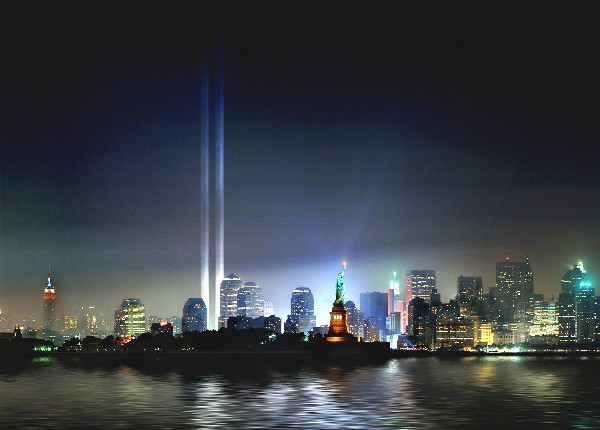
I painted several paintings of the angels kneeling by the FF and of the
collapsed World Trade Center
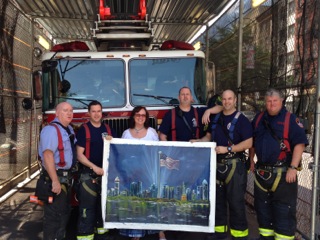
I have a painting in the Cincinnati Fire Museum of the Towers burning and a
Angel caring a FF to heaven
After painting this my dream was to donate it to NYC Ladder 3 !!
Thanks for helping make it Happen !!
This painting is on the 911 Memorial web page
Judy Johnston
Sent from my iPhone
August 2010: Quilt
From: Tom Lombardo
Date: August 15, 2010
Subject: FDNY Ladder 3
Hi,
I visited Ladder 3 last month, and there was a reason.
Every 9/11 I climb 110 floors in the Denver StairClimb, in memory of the 343.
I was given Jeff Giordano’s name and picture, and climbed for him.
I wanted to tell the family I did it for him, but was unable to locate it.
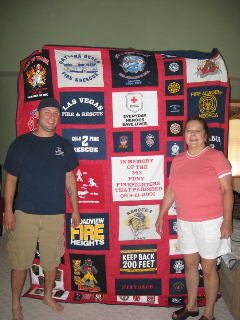
My mother took all my old fire shirts and patches that I had collected for over
10 yrs and made a quilt, which I presented to them on July 25th.
Engineer Wind was nice enough to show us around.
The air felt a li’l thick, and we felt awkward, but I wanted them to have
the quilt.
I hope they hung it up.
For I couldnt find Jeff’s family, the brothers are the closest I can get.
I had so much to say, and for some reason, I didn’t feel it was the right
time.
Here is a picture of the quilt.
(That’s me and my mom with the quilt.)
Tommy Lombardo
Castle Rock Fire Dept.
October 2007: Paddy Brown book
October 2007: A new book
Miss You, Pat: Collected Memories of NY’s Bravest of the Brave,
Captain Patrick J. Brown about the fallen Ladder 3 captain has been
published this month.
See the Paddy Brown page for more information.
September 2006: Paddy Brown documentary and
letters
September 2006: See the
Paddy Brown page for emails
from Ireland on the Finding Paddy documentary.
September 2006: Remembering an August 2001 visit
to Ladder 3
Hi
My name is Tracy. My husband is a firefighter in Amarillo, TX.
I work for a dentist office that often travels to great cities such as New York
for conventions.
In August of 2001 our office visited NY.
I always try to take pictures of anything fire dept related so I can share them
with my husband.
I was lucky enough to meet some firemen from Ladder 3 during our last night in
NY.
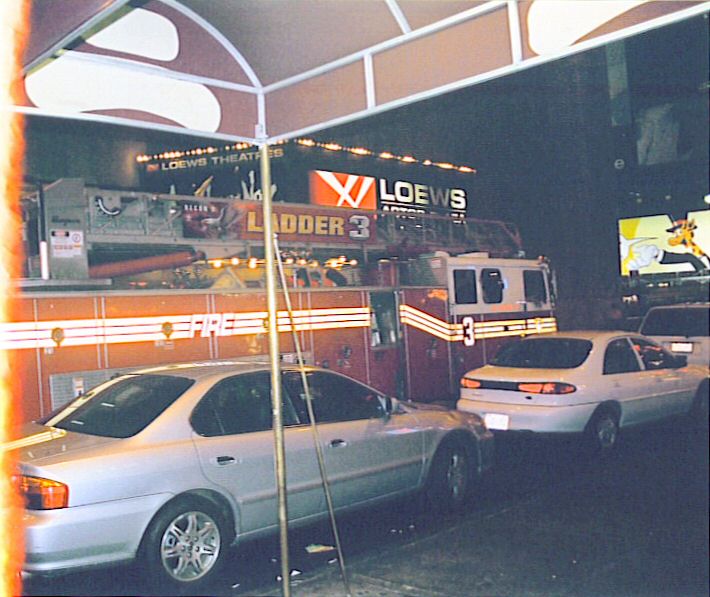
I am enclosing pictures of myself with 2 of the firemen and also one of the
truck.
[click each image for full picture]

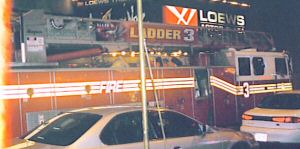
I was devastated a month later when the towers fell.
I kept thinking how I was just in the buildings less than a month before and
that it was possible the nice firefighters I had met could have been killed in
that tragedy.
I found a NY firefighter online not long after that and he looked at the pics
and assured me that these men were still living.
With the 5 year anniversary tomorrow, the attack has been on my mind and all
those that were killed especially the firemen.
I looked today and saw that many men were killed that worked from Ladder 3.
I just want you to know that I am so very sorry that this had to happen and I
will always have NY and the fire department in my heart.
Tracy
September 10, 2006
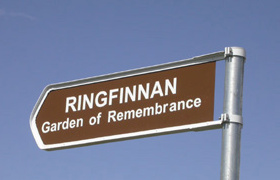
Kinsale Garden of Remembrance
Kinsale Garden of
Remembrance is dedicated to the memory of Fr.
Michael Judge, Chaplain in the New York Fire
Department and to the 343 brave fire fighters,
who so courageously lost their lives in New York
on September 11th 2001.
View back to Kinsale
from Ringfinnan The Kinsale Garden
of Remembrance was initiated by Kathleen Murphy,
a nurse in New York City. She was born in
Ringfinnan, Kinsale and her family continue to
reside here. The first tree planting ceremony
took place in November 2001 and this was
followed by an official dedication of the garden
on 10th March 2002 by the then Minister for
Agriculture & Food, Joe Walsh, T.D.
The dedication ceremony was attended by Irish
relatives of the deceased New York fire
fighters. Many of the fire fighters were of
Irish descent and the garden has been visited on
a regular basis by United States visitors to
Ireland. Attached to each tree is the name of
each individual fireman.
Thanks—your stories are welcome.
(CBS) A total of 343 firefighters
perished at the World Trade Center. They are
American folk heroes now, symbols of heroism
and sacrifice.
But 12 months ago, they weren’t icons. They
were regular guys, commuters mainly, men with
mortgages and lawn mowers.
What’s also been forgotten is that they were
survived not only by wives and children,
siblings and parents but by thousands of guys
just like them. Other firefighters who made it
through that day downtown, or who never got
there. Bob Simon reports.
60 Minutes II spent time this past year at
Ladder 3, where they lost 12 men—half its members.
The planes hit the World Trade Center right in the middle of a shift change and
many of those lost from Ladder 3 weren’t even on duty.
Eight-year veteran Mike Moran wasn’t working that day, but he wanted to
be there.
He raced in to the Trade Center from his home in Rockaway Beach but got caught
in traffic.
Imagine owing your life to a traffic jam.
He doesn’t consider himself lucky:
“Far from lucky, I think.
I mean—not lucky that I survived—I’m lucky that I knew all
those guys.
Some people go through their entire lives without working with the caliber of
guys that I knew before Sept. 11.”
One of the guys he knew and lost that day was
his brother John, a Battalion Chief. “I
pictured us living side by side in the same
neighborhood for the rest of our lives. And
that’s—that’s gone now. I do look at it that
I was lucky to have him,” Moran says.
The nights and the days after the attack
became a muddle of searching and talking and
crying. Tears shed by men who before Sept. 11
did not do a lot of crying. Steve Browne was
the surviving senior officer.
“Just waking up every morning and being
like—this is not a dream, you know and you have
your morning cry and then you do what you
gotta do—you know? And before you know the
memorials and the funerals started and that
was just a whole ’nother thing on its own,”
says Browne.
The men who died left 16 children behind—16
children and wives, brothers, sisters,
parents. Ask anyone who’s ever lost an arm or
a leg... For a long time, you feel its still
there. That’s how the men of Ladder 3 felt
about their lost brothers.
“I think about them all the time. I think they
pull up in my driveway in a car and they they
all are in a car. I’ll be cutting my lawn, be
driving, cutting my lawn and I’m thinking
about these guys, going through my head—why
am I here and they’re gone,” says 15-year
veteran Jerry Brenkert.
Jimmy Wind spent 20 years at Ladder 3. He says
he misses some of the little things, like
playing foosball with Timmy McSweeney, a
father of two.
Says Wind: "Timmy and a bunch of the guys
would play and as they would score Timmy would
always let out a yell. You know, sometimes you
almost think you hear that once in a while—‘Whoooo.’
You know, nobody’s been playing it—it’s got
quite a bit of dust on it now.”
Mike Moran’s firefighter father died when Mike
was a teen-ager. Mike’s brother, John, became
his new father figure. And now he was gone
too.
“I remember him telling me on the phone one
night that whenever he closed his eyes. all he
could say was ‘I lost my brother.’ That was
hard, hearing that from him,” says Peggy
Moran, Mike’s mother.
Brothers cannot be replaced. But replacements
had to be found for the men who died at Ladder
3. There was work to do. Replacements were
needed, but not necessarily wanted.
Brenkert didn’t want to see any new faces:
“And it seemed like, you know, it was tough to
come by—kind of to lose 12 guys in a
firehouse and all of a sudden, a couple of new
guys, and I didn’t like it. So, maybe I was
tough on ’em. I was angry—these guys are
gone and I had a lot of hate in me. A lot of
hate and anger.”
“You just kinda kept to yourself in the
beginning,” says Jerry Perrillo, a probie
assigned to Ladder 3.
The remains of only two men from Ladder 3 were
recovered by November. With no bodies to bury,
they had memorial services for the 10
others—the last one for Captain Paddy Brown. Brown
was a Fire Department legend. His specialty:
pulling people out of burning buildings.
Firefighters heard him reporting on Sept. 11
that Ladder 3 was trying to rescue people
somewhere around the 40th floor of the north
tower.
Says Moran: “Paddy had pretty detailed
instructions if he should ever die in a fire
what he wanted done. He had his place in
Central Park picked out where he wanted his
ashes spread. And his brother Mike was kind of
disappointed that we hadn’t found his body,
that we couldn’t fulfill this—it seemed like
his only real wish, like what he wanted done.
So the next best compromise he felt was if we
could plant a tree in his honor. So, we kind
of had a stealth mission in the middle of the
night, to go plant a tree.”
Moran thought that after that, he could begin
trying to return to routine. But the bodies of
their comrades began turning up late in
November.
“And we started all over again,” says Brenkert.
“The funeral. You’d have a wake, then a
funeral and a burial and it started all over
again.”
You simply don’t come out of something like
this unchanged. For some of the survivors of
Ladder 3, the change was not only
psychological or spiritual. Some of the men
were moved to change the facts of their lives.
“I’ve since separated from my wife, and I’m
looking to have a better quality of life for
myself,” says Wind. “Now after this it makes
me realize how precious life is and what a
short time that we have on this earth."
Others went about it another way. Lieutenant
Steve Browne remembers sitting with Mike Moran
in the wreckage on the night of Sept. 12,
talking about Mike’s girlfriend, Donna…
“Mike started talking about how much Donna
meant to him and how she’s been great,” Browne
says. “We said some really nice things. And I
kind of said, ‘You should marry that
girl’—and he kind of looked at me and said—‘I’m
gonna.’”
That marriage was the first time in a year
that the men of Ladder 3 had gotten together
for a happy occasion. And it was, at least in
part.
“When I danced with my mother, and she said
something along the lines of—‘Oh your
brother would love this’—and that was pretty
much—we were both in tears after that,” says
Moran.
And then summer came. While grief counselors
were still filing into the firehouse, the best
therapy seemed to be doing what they’d always
done: fighting fires.
The guys started paying attention to the new
guys, too. Perrillo says that the veterans
became friendlier.
Brenkert says a brother of one of the fallen
firefighters gave him some good advice: "You
gotta let it go. I mean, it’s not their
fault—it’s not the new guys’ fault. They’re there
and these guys are gone."
One year after the fall, the heat is beginning
to pass. The colors beginning to change.
“Every time you think about something now with
the passage of time, it’s not all sad now,”
says Moran. “It’s not just that shock that
they’re gone. And it’s—you’re starting to
remember them with a smile on your
face—instead of being sad all the time.”
Pat was my neighbor.
A quiet guy who always smiled and said hello on the elevator.
And if anyone knows a Manhattan apartment building, that was a lot to get from
a neighbor.
Before 9/11, I’m not sure how many people in the building knew about his
legendary reputation as a fireman, I know that I didn’t.
He was just “the friendly fireman from 11” to us—the guy who
helped a neighbor who was recuperating from a bad car accident, got
someone’s car started, gave someone a ride to work, gave a kid a boost to
push the elevator buttons, stuff like that.
Since last September 11th and particularly since
his memorial mass on 11/9, we’ve learned that
his good deeds around Stuyvesant Town were
nothing compared to what he did in his life.
Since last year, I’ve been making a concerted
effort to “Do a Paddy Brown” every day so that
his legacy will continue.
I think going forward,
I may even do it as a “Ladder 3” to honor the
twelve incredibly special men that were lost.
During the morning of Friday, September 13th, an
area near Stuyvesant Town will be dedicated to
his memory.
Don’t know yet what time it will be.
It’s being coordinated by the office of City
Councilwoman Eva Moskowitz. more info, contact
her pr person,
Ingrid Lemmey
(email: ilemmey@earthlink.net)
God Bless the twelve men lost on 9/11, their
families and the FDNY.
We think doing a “Paddy Brown” every day is a
brilliant idea—everyone should try it.